Payrolls - Weaker Than They Look
Downward revisions ts are likely to continue
Bottom Line
Payroll data is likely overstating underlying labor market strength. Revision bias has turned negative, and divergence between real-time and revised trends has widened.
Summary
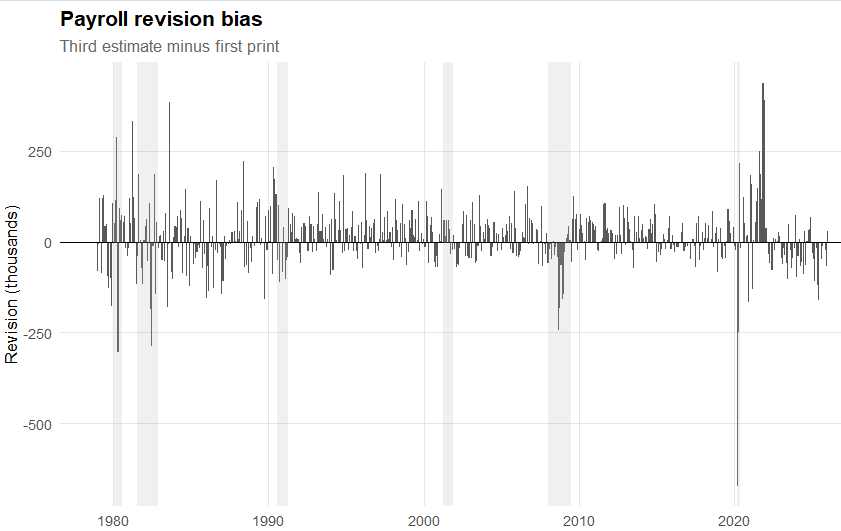
Payroll revisions indicate that biases in initial estimates are highly autocorrelated and are cyclical. Recent payroll revisions have been predominantly negative The evidence suggests that we should expect continuing negative revisions in the months ahead.
Chart 1: Payroll Revision Bias (1st estimate vs 3rd)
Third estimate minus first print.
Source: BLS
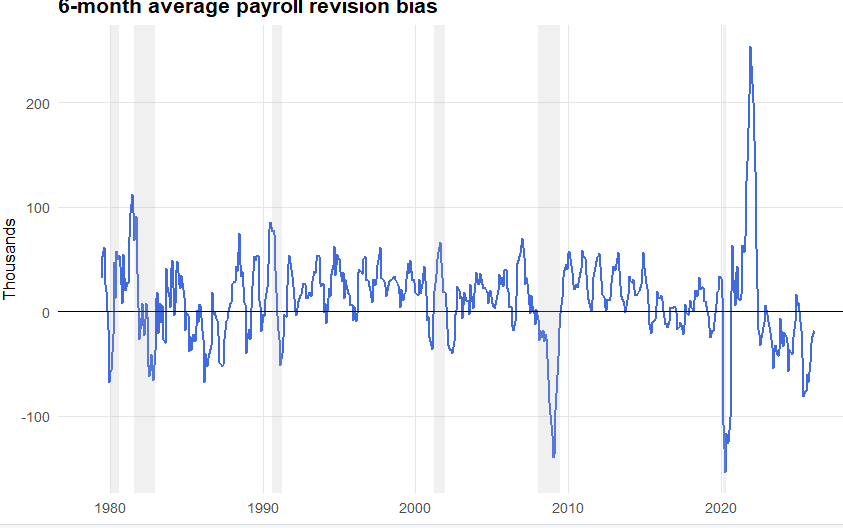
Chart 2: 6-Month Revision Bias
Rolling average revision bias highlights regime shifts.
Source: BLS
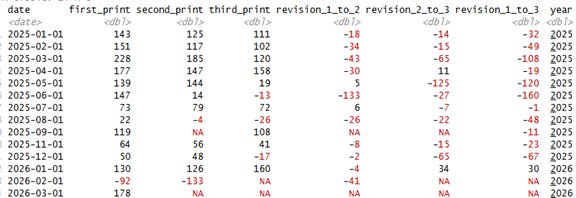
The rolling average of six-month revisions frequently falls around recessions. There has been a downward trend in the average six-month revision since 2023, with substantial revisions in March, May, and June last year. Since this period coincides with the start of the Trump Administration's changed immigration policies, that could be a factor, though declining job openings suggest that demand was declining as well. The tendency towards negative revisions set in during 2023, before the immigration changes (Chart 3). Revisions in every month since mid-2025, except January 2026, have been negative between the first and third estimate (the numbers do not include benchmark revisions). Revisions between the second and third estimates have been predominantly towards weaker payrolls.
Table: Revisions from January 2025 (000s)
Source: BLS
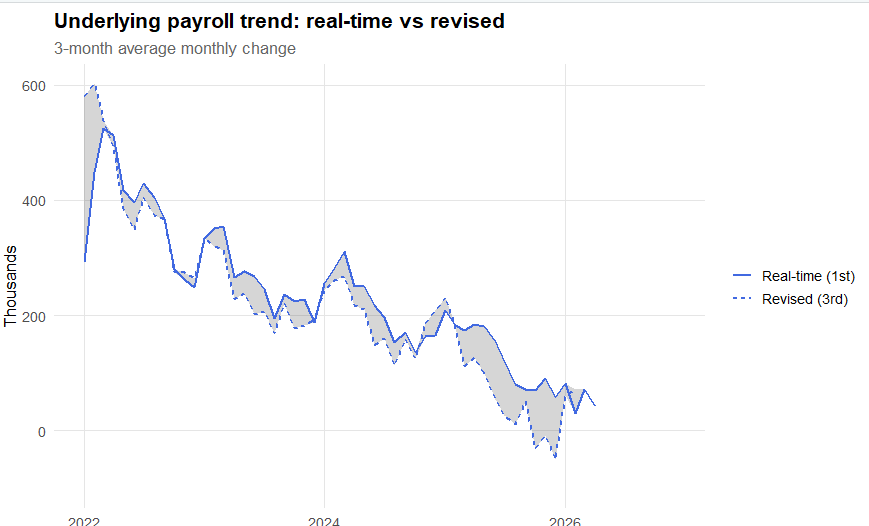
The three-month average of revisions provides a guide to what we might expect over the months to come. Chart 3 strongly shows that downward revisions should be the base case
Chart 3: Real-time vs Revised Trend
3-month average payroll growth (real-time vs revised).
Source: BLS
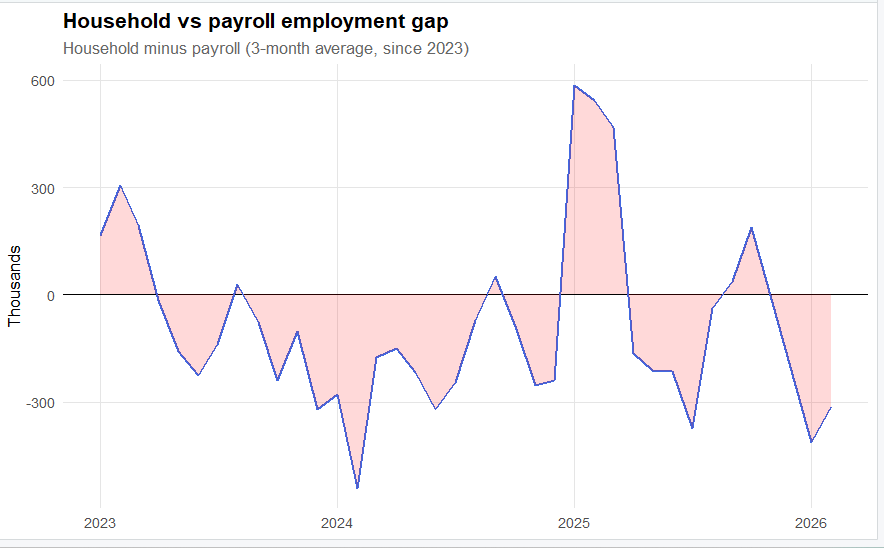
Chart 4: Household - Payroll Gap
Source: BLS
The latest household employment m/m change was far weaker than the payroll change. While there are issues with response rates in the household data and with BLS funding, the household data does contain information about likely future payroll revisions. The household-payroll gap is correlated positively contemporaneously and at short horizons with payroll revision bias.
Conclusion
Revision dynamics, together with the household survey, suggest underlying labor market conditions are weaker than the headline payroll data imply. We should expect continued downward adjustments from the first prints.